
Simple steps to reduce year-round UV exposure
By Chris Maday Schmidt
You’re preparing for another day on the job. The forecast calls for an overcast sky, so you grab your usual gear — hardhat, gloves, protective eyewear, lunchbox, a day’s supply of water — and head out the door.
But before you step outside, there’s one more question worth asking: have you planned for sun exposure?
According to the Skin Cancer Foundation, more than 3.3 million people in the United States develop over 5.4 million nonmelanoma skin cancers each year, making it the most common form of cancer in the country.
The good news is it’s also one of the most preventable forms of cancer, largely because the primary cause — overexposure to ultraviolet radiation — is something workers can actively guard against.
One of the biggest misconceptions about sun safety is it’s only a concern during the hottest months of the year. In reality, the American Cancer Society notes that UV rays are present year-round. They penetrate cloud cover, reflect off surfaces and can be especially intense at higher elevations.
For construction professionals and others who spend long hours outdoors, that exposure accumulates over time — often without immediate symptoms.
Across the industry, sun safety is increasingly treated as a standard part of jobsite safety rather than a seasonal reminder. Feedback from construction professionals nationwide, including an informal online survey conducted by Construction Superintendent, indicates that many contractors incorporate sun safety into regular safety meetings and toolbox talks. These discussions often take a practical, hands-on approach, reinforcing not just awareness but daily habits that help reduce risk.
In regions such as the Southwest, where sun exposure is a constant factor, sun safety is often emphasized through both routine safety briefings and dedicated training. However, even in areas with milder climates or more variable weather, contractors report that the topic remains relevant throughout the year. Many crews place particular emphasis on sun protection from early spring through fall, when UV levels are typically higher, but acknowledge that precautions shouldn’t stop when temperatures drop.
On many jobsites, sun safety is supported through both policy and practice. Superintendents commonly make sunscreen available to workers in the field and encourage its use as part of the daily routine — often applying it before the workday begins and reapplying as needed. Some crews keep sunscreen in lunchboxes or gang boxes for easy access.
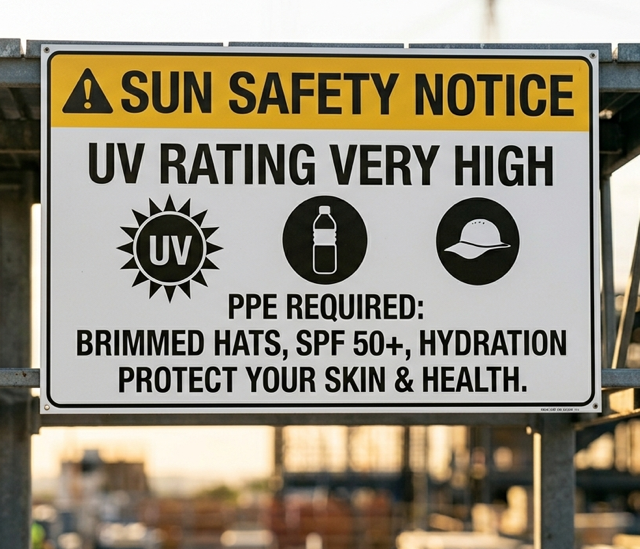
Protective clothing is another key component. Long-sleeve shirts, neck shades and wide-brim attachments for hardhats are frequently provided or encouraged, offering an added layer of defense against direct exposure. Tinted or UV-resistant safety glasses not only meet eye protection requirements but also help shield against harmful rays. In some cases, shade canopies are set up in active work areas to give crews a place to cool down and limit prolonged exposure during breaks.
These measures are most effective when paired with consistent messaging. Regular reminders — whether during morning briefings or informal check-ins — help reinforce the importance of sun safety and ensure it remains top of mind, even on cloudy or cooler days when the risk may feel less obvious.
Practical protection on the jobsite includes:
- Wearing a hardhat with a full brim or sun shade to protect the face, ears and neck
- Applying a broad-spectrum (UVA/UVB), water-resistant sunscreen with SPF 30 or higher at least 15–30 minutes before going outside, and reapplying every two hours — or more often with heavy perspiration
- Choosing light-colored, long-sleeve clothing to help reflect sunlight and reduce direct exposure
- Wearing gloves to protect the hands, which are often overlooked but highly exposed
- Using UV-resistant, wraparound safety glasses to safeguard the eyes.
In addition to personal protective measures, jobsites can support sun safety through preparedness. First-aid kits should include sunscreen, electrolyte-replacement fluids, aloe or other cooling agents, and over-the-counter pain relievers such as ibuprofen or acetaminophen.
It’s also important for workers and supervisors to recognize when sun exposure becomes a more serious health concern. Severe sunburn, heat exhaustion and other heat-related illnesses can escalate quickly if left unaddressed. Immediate medical attention may be necessary if burns are accompanied by significant swelling — particularly around the face and neck — or if extremities become numb, discolored, or unusually cold.
Sun exposure may feel like an unavoidable part of working outdoors, and for many seasoned professionals, it’s something they’ve managed for years. But the long-term effects are cumulative, and the risks shouldn’t be underestimated simply because they aren’t immediately visible.
The reality is that small, consistent actions — applying sunscreen, wearing the right gear and taking advantage of shade — can make a meaningful difference over time. By treating sun safety as a routine part of jobsite preparation, crews can better protect themselves not just for the season ahead, but for the long run.
Chris Maday Schmidt, freelance writer.
 Join our thriving community of 70,000+ superintendents and trade professionals on LinkedIn!
 Search our job board for your next opportunity, or post an opening within your company.
 Subscribe to our monthly
Construction Superintendent eNewsletter and stay current.
Subscribe to our monthly
Construction Superintendent eNewsletter and stay current.