

How connected field information gives superintendents more time to manage the job
By John Sheedy
Ask a superintendent where the day went, and the answer rarely starts with the work. It starts with the phone. One of the biggest drains on a superintendent’s time is the distance between the work and the information needed to run it.
Superintendents field dozens of calls and answer many more text messages each workday. Then comes the paperwork: pre-task safety inspections, daily stand-ups, environmental and stormwater checks, daily logs, timecards. Much of it is essential, and none of it is optional. But it adds up to hours of a superintendent’s day and often spills into evenings at the kitchen table. A 2026 industry survey found that 73% of construction companies still manage projects primarily through spreadsheets and paper systems.
The job has always been to keep the site running safely, on schedule and to spec. What’s changed is how much of the day goes to chasing and recording information instead of acting on it.
And the cost goes beyond any single project. Associated Builders and Contractors estimates the industry needs to attract 349,000 new workers in 2026 alone, with most of that demand coming from people retiring rather than new work. The industry can’t afford to burn out its superintendents or ask the next generation to accept 14-hour days spent mostly on the phone and filling out forms.
That’s where digital site management comes in. By bringing information closer to where the work is done, it helps superintendents spend less time tracking it down. Project information stays in one place and is accessible from a tablet or laptop in the field, reducing the need to pick up the phone and call the superintendent.
Fewer interruptions in the field
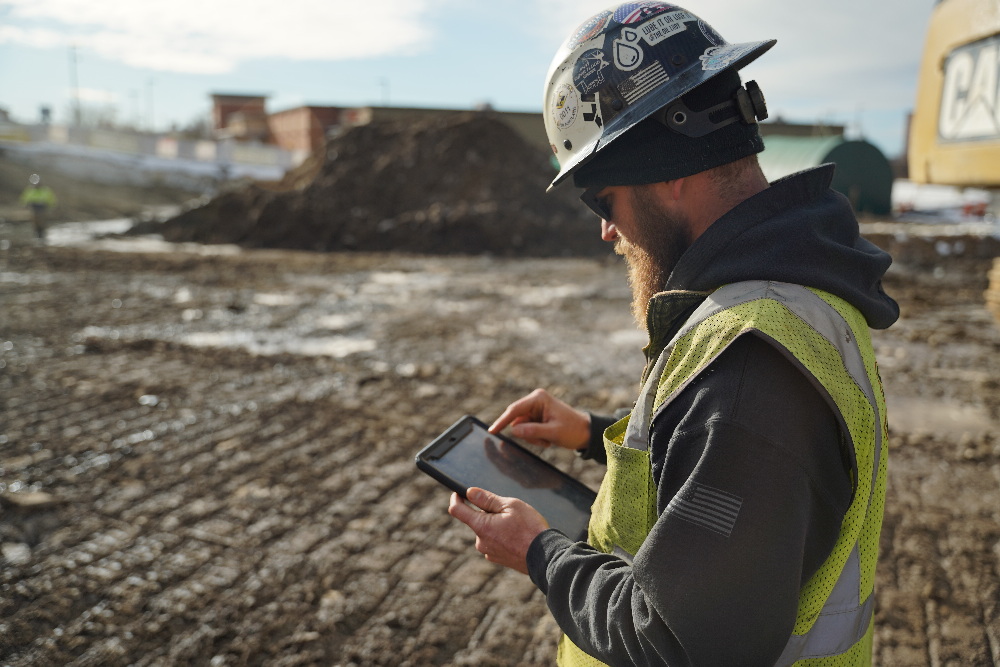
A new design revision used to mean a drive to the office, a USB stick or waiting for a surveyor to load it into each machine. Today’s site management software lets teams send updated models to machines and field devices remotely. Those files can also be opened, viewed and checked on a tablet or laptop in the field.
With 3D visualization tools in the field, superintendents and their teams can measure and gain insight from survey data, design surfaces and up-to-date site conditions instantly. That makes it possible to identify and address problems before they begin to erode margins — issues that once required a trip back to the office and a call to the engineer.
The same access works further down the chain. A foreman or grade checker can open the latest model on a tablet to check a surface or confirm an elevation, instead of calling the superintendent or waiting for the surveyor. That’s one less interruption and more time for the superintendent to focus on the job.
Ohio paving contractor Buck Brothers Asphalt Paving & Concrete moved to precise, model-driven grading on a 100,000-square-foot parking lot rebuild. Co-owner Jacob Buck said their old methods sometimes required rework. Now he knows everything they pave is the right thickness and drains correctly.
Many calls to the superintendent happen for one reason: that person is the only one who can see the plan. When the schedule, latest drawings and delivery status live in a shared system that foremen, crews and dispatchers can check themselves, the questions stop coming to one person. The superintendent can make decisions instead of relaying information.
Less time on paperwork
Daily logs, labor hours, equipment hours and production quantities are often written down on paper during the day and typed in at night. Mobile field tracking tools let foremen record that data at the source, from a tablet or phone, online or off. Logs can be copied forward from the previous day and adjusted, timecards can be signed electronically and quantities can be sent straight to the office. The superintendent reviews and approves; nobody has to retype the information.
Progress documentation is getting the same treatment. Instead of snapping photos and sorting them later, a superintendent or foreman can walk the site with a 360 degree camera. AI software maps the route and pins each image to the right spot on the drawings, building a visual record that shows progress against the plan over time. Project managers can tour the site virtually instead of driving out or calling for an update. When an issue turns up, the image goes straight into the RFI or change order, so no one has to describe the problem from memory.
When field data flows in daily, planned and actual production can be compared the same day. If a crew falls short of its target on Tuesday, the superintendent can adjust Wednesday’s crew assignments, sequencing or equipment before a small miss becomes a lost week.
At Bituminous Roadways, field teams record labor hours, production quantities and material and equipment use on electronic field logs each day. Correctly coding labor hours at the source has streamlined payroll. Dispatchers, foremen and superintendents share a real-time view of crews, equipment, materials and trucks. “This centralized view eliminates the need for manual coordination with multiple teams,” said construction technologist Nate Larson. Bituminous Roadways’ Information Systems Technology Manager Kim Scales said the company can now dispatch more than 200 trucks in a day, compared with 80 in previous years.
When estimating and field tracking systems are integrated, bid data can populate field logs directly. This saves time re-entering data, helps avoid mistakes and ambiguities, and makes it easier for the field team to build the job according to how it was bid. Likewise, actual production data from field logs can flow back to the estimating software and be used to make future bids more accurate.
More time to stay ahead of the schedule
On many jobs, the schedule still lives on a desktop in the office. Often there’s more than one: a master schedule, a lookahead in a spreadsheet, a whiteboard in the trailer, each in its own format. The schedule gets handed to the field, and the superintendent spends the week reconciling versions and working around them. The fix is a centralized online schedule and field plan for work execution that everyone can see, updated in real time from the field, the office and other project systems.
AI is starting to take on some of the reconciling work. New scheduling tools can improve scheduling visibility by connecting a master schedule directly to live project data — from look-aheads and RFIs to weather forecasts, delivery lead times and other variables. Assisted by agentic AI, these solutions continuously track shifting conditions, evaluate risk and suggest actionable schedule adjustments for teams to review and approve. This helps shift project management from reactive delay tracking to proactive delay prevention. Superintendents still drive the work, but with less ambiguity and more time to focus on delivering the plan rather than validating it.
None of this replaces a superintendent’s judgment. Software only knows what it’s told, and someone with years on jobsites still has to decide whether what it’s showing is right. The goal is to free up that judgment, so the most experienced person onsite spends the day leading crews, solving problems and making sure everyone gets home safe.
John Sheedy is a director of product management at Trimble.
 Join our thriving community of 70,000+ superintendents and trade professionals on LinkedIn!
 Search our job board for your next opportunity, or post an opening within your company.
 Subscribe to our monthly
Construction Superintendent eNewsletter and stay current.