
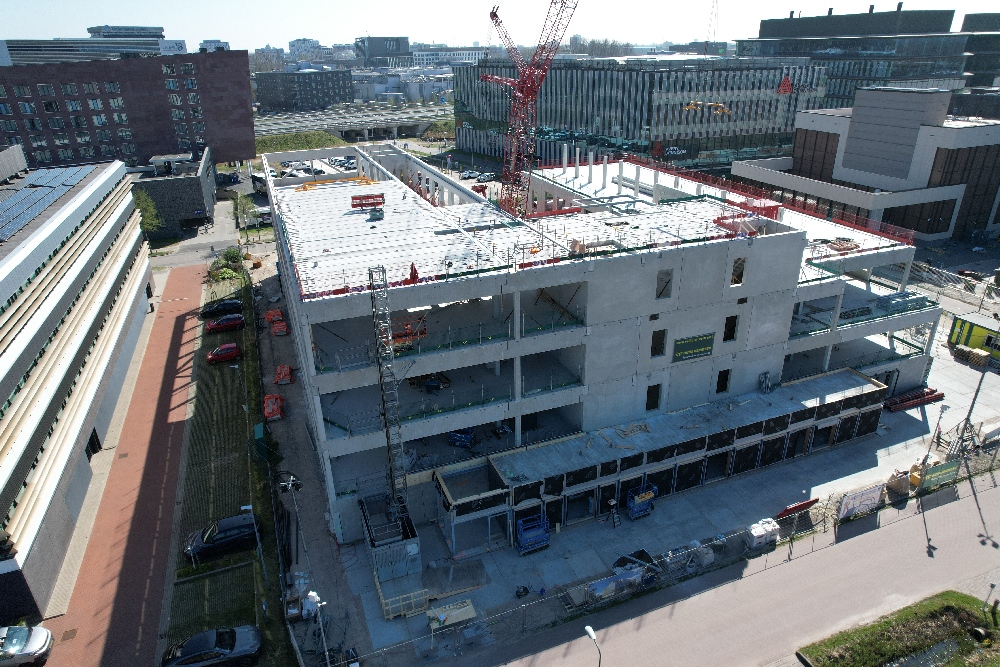
Located in the Leiden Bio Science Park West in the Netherlands, Nexus Leiden comprises 9,100 square meters over four large floors, housing laboratories and offices to support the critical work of life science, health and pharmaceutical companies.
With its construction site nestled in a busy science park, modular construction techniques were employed to minimize the timeline, space and onsite disruption of the building’s construction.
Working closely with the project’s main contractor, Dura Vermeer Bouw Zuid West, and concrete supplier Holcon BV, Mammoet supported the assembly of the building’s shell structure, which was made of precast concrete and steel.
A centerpiece steel staircase structure for the atrium also needed to be installed, besides the floor slabs and appropriate connections needed for concrete pouring.
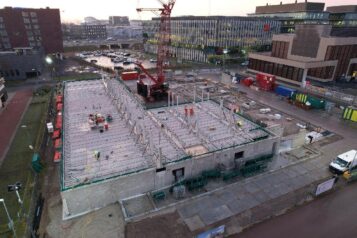
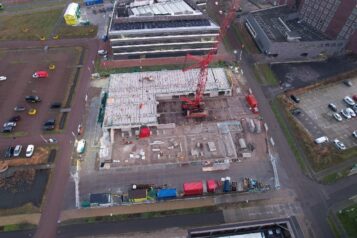
With no available space outside the build site to set up a crane or laydown area for the 2,400 assembly parts, a smart engineering approach was needed. The solution was just-in-time deliveries for the building blocks, and a prefabricated construction method that saw the entire structure assembled using a single crane positioned inside the building.
Engineers were brought into the project at an early stage, to consult during FEED, helping to guide the constructability plan and ensure the critical path was optimized. With a just-in-time approach taken, strong communication with the German factory fabricating these elements was essential. Delivery schedules were agreed well in advance to streamline production and delivery schedules.
At peak times, trucks arrived at the site in two-hour intervals, six to eight times a day, bringing the materials needed. A single 250 ton crawler crane was selected to lift the components in accordance with the assembly program. Chosen due to its compact and narrow footprint, the crane was positioned in the center of the building and construction proceeded around it, in a ‘U’ shape.
Assembly was divided into three phases: the back and side sections; the extension of the two side sections and, finally, the middle section, where the crane would first need to crawl backward to create enough ground space.
The team was also involved in many of the lifting plans — detailed drawings where every element, from the steel columns to the concrete wall panels, had a designated number. Consequently, during the construction phase, it was like following assembly instructions for a piece of prefabricated furniture, only on a much bigger and more complex scale.
 Join our thriving community of 70,000+ superintendents and trade professionals on LinkedIn!
 Search our job board for your next opportunity, or post an opening within your company.
 Subscribe to our monthly
Construction Superintendent eNewsletter and stay current.
Subscribe to our monthly
Construction Superintendent eNewsletter and stay current.