
A Case for Measuring Sustainability in Decades, Not in Moments
By Thomas L. Ketron
I’ve spent more than 20 years around prefabricated concrete building systems — first on the manufacturing side, now working for the broader industry on sustainability initiatives. In that time, I’ve come to believe sustainability conversations are missing a dimension.
Today’s dominant framing measures a structure’s environmental performance at a single moment: embodied carbon of the completed project. It’s an important number, but it’s also the easiest one to calculate, and that has let it stand in for the whole conversation. What’s missing is time — how a building performs, and keeps performing, across the decades it’s asked to stand.
That’s a different way of thinking about sustainability than most of us in construction are used to. The conversation tends to arrive as an estimated per-product global warming potential figure, calculated once, required in specifications, yet disconnected from anything that happens on your site after occupancy.
I want to make the case for putting time back into that conversation: not a number captured at delivery, but performance that compounds, decade after decade.
Engineered to outlast
Ask any construction superintendent what they want from a structural system and you’ll get a practical list: consistent quality, a schedule you can actually hold to, fewer surprises in the field and a building that doesn’t come back to bite you five years after occupancy. That list, it turns out, forms the basis for the sustainability case for precast.
Precast concrete components are manufactured under factory-controlled quality-assurance programs, with the same discipline applied to every piece, every time. That consistency shows up on your jobsite as fewer field defects and less rework, and decades later as a building that needs less maintenance because the quality was engineered in at the outset.
Durability and low maintenance are not a footnote to sustainability. They’re the substance of it. A structure engineered to outlast the moment of its construction — built to perform for 50 or 100 years without major intervention — has a fundamentally different environmental and economic profile than one needing major repair or replacement within a couple of decades. Every repair avoided, every early replacement that doesn’t happen, is embodied carbon, labor and material costs that never have to be spent again.
Resilience is the other half of the story
Durability naturally invites a conversation about resilience — especially as severe weather grows more frequent and prolonged, and infrastructure is asked to do more with less downtime.
Precast and prestressed concrete systems bring real strength to that conversation — resistance to hurricanes, tornadoes, seismic events, fire and blast, among other hazards. A building that stays operational throughout severe weather, or comes back online faster afterward, isn’t just a safer building. It avoids the resource cost of a rebuild, the disruption of extended downtime and the risk exposure owners and insurers increasingly price in from day one.
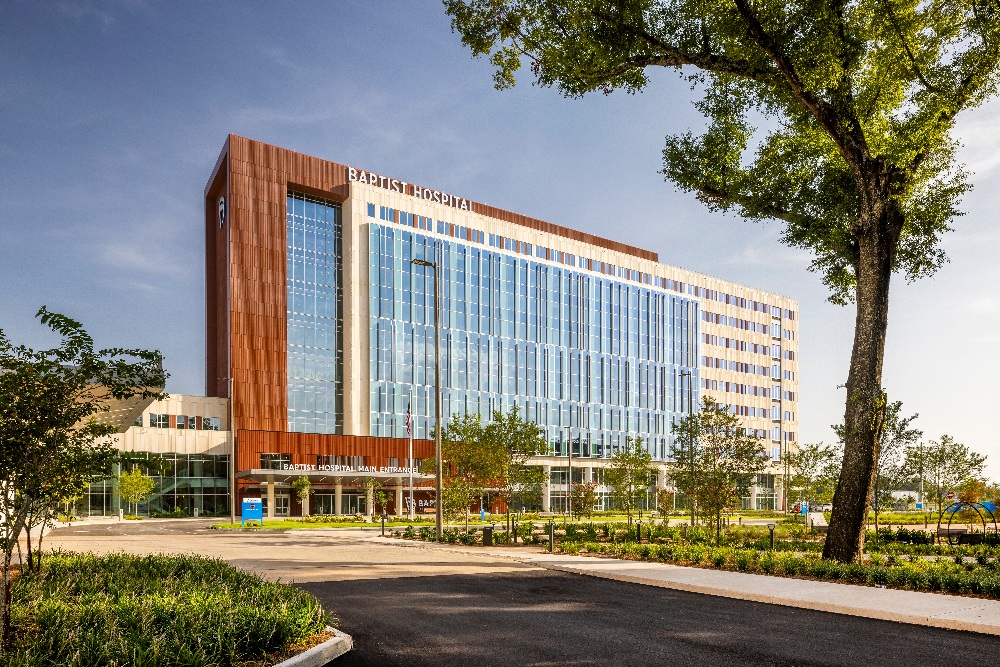
Baptist Hospital in Pensacola, Florida is a real test of that argument: an 850,000-square-foot regional medical center enclosed in nearly 1,000 architectural precast panels, engineered to withstand a Category 5-level hurricane and a 1,000-year storm. During a recent major storm that met both thresholds, the hospital stayed fully operational, running off-grid for roughly seven days with no failure of the precast concrete enclosure system. Sustainability and resilience aren’t two separate conversations anymore. On the jobsite, they’re the same conversation.
Proof, not just position
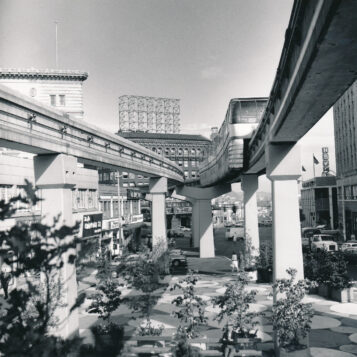
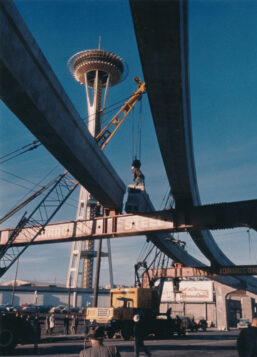
None of this works as an argument on faith alone, and the precast concrete industry has been documenting it for years. PCI’s “Precast Protects Life: Excellence in Longevity” compendium profiles precast projects from across the country still standing and still performing, some dating back to 1951. Seattle’s monorail is one of them: its original precast guideway has run continuously since 1962. Atlanta’s Centennial Olympic Stadium, built entirely of precast components for the 1996 Games, was reconfigured in just seven months into Turner Field, home of the Atlanta Braves for the next two decades, and is now a college football stadium. That’s durability and adaptability working together, in structures anyone can go stand in front of today.
What this means on your next job
You don’t need to become fluent in embodied carbon accounting to make this case on your own projects. You already make it every time you push for a system that shows up onsite the way it was specified, holds its schedule and doesn’t generate callbacks. That instinct — for consistency, quality and lasting performance — is the sustainability argument. It’s just usually described that way years after the fact, once the building has quietly done its job for a decade or three without anyone having to think about it.
That’s the dimension I’d ask this industry to put back into the conversation: not a number captured on delivery day, but a performance record built one well-constructed, well-maintained decade at a time. It’s a case that construction superintendents have been making with their own standards and instincts for years. Sustainability that strengthens over time is a standard that precast is already built to meet.
Thomas L. Ketron, LEED AP, is director of resilience & sustainability at the Precast/Prestressed Concrete Institute.
Bridging Past and Present
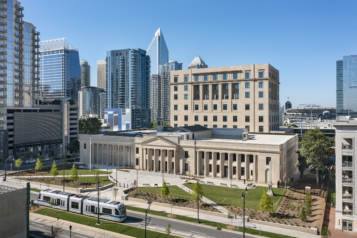 For more than a century, the Charles R. Jonas Federal Courthouse has stood as an iconic symbol of Neoclassical Revival architecture in downtown Charlotte, North Carolina. With the building beginning to show signs of age, the General Services Administration initiated a modernization project to include upgrades to the existing courthouse along with the addition of a new, eight-story, 198,000-square-foot annex. Honoring the building’s history was achieved with more than 800 architectural precast concrete products, including wall panels, balconies, cornices and more. One challenge was constructing the eight-story annex to pay homage to the building’s past. Limestone was considered, but the project team elected precast as concrete, a cost-effective solution that would closely simulate the texture and tone of the original building. “We decided to use precast concrete as our cladding because it was a great aesthetic and tactile match to limestone, and it was able to significantly contribute to the courthouse’s blast-protection requirements,” said Rob Hsin, principal for Jenkins Peer Architects. “Creating a complementary cladding material next to the historic limestone courthouse was simplified greatly through the ability to customize textures and colors with precast concrete.” Sustainability and environmental performance were critical to the project’s design, in part due to the U.S. government’s stringent targets. Thanks in part to using precast concrete products, the courthouse achieved both LEED Gold and SITES Silver certifications — an uncommon dual accomplishment for a federal building. Additional sustainability strategies included high-efficiency heating, ventilation and air-conditioning systems; reduction of construction waste and using regional low-maintenance materials, including precast concrete, that support long-term environmental performance. Precast concrete provided significant cost savings with faster installation, enhanced durability and accelerated construction, while also meeting blast-resistance requirements and satisfying all architectural goals. The project was honored with 2025 PCI Design Awards for Best Sustainable Design and Public Building. Sidebar by Mason Nichols, a Grand Rapids, Michigan-based writer and editor who has covered the precast concrete industry since 2013. |
 Join our thriving community of 70,000+ superintendents and trade professionals on LinkedIn!
 Search our job board for your next opportunity, or post an opening within your company.
 Subscribe to our monthly
Construction Superintendent eNewsletter and stay current.
Subscribe to our monthly
Construction Superintendent eNewsletter and stay current.