
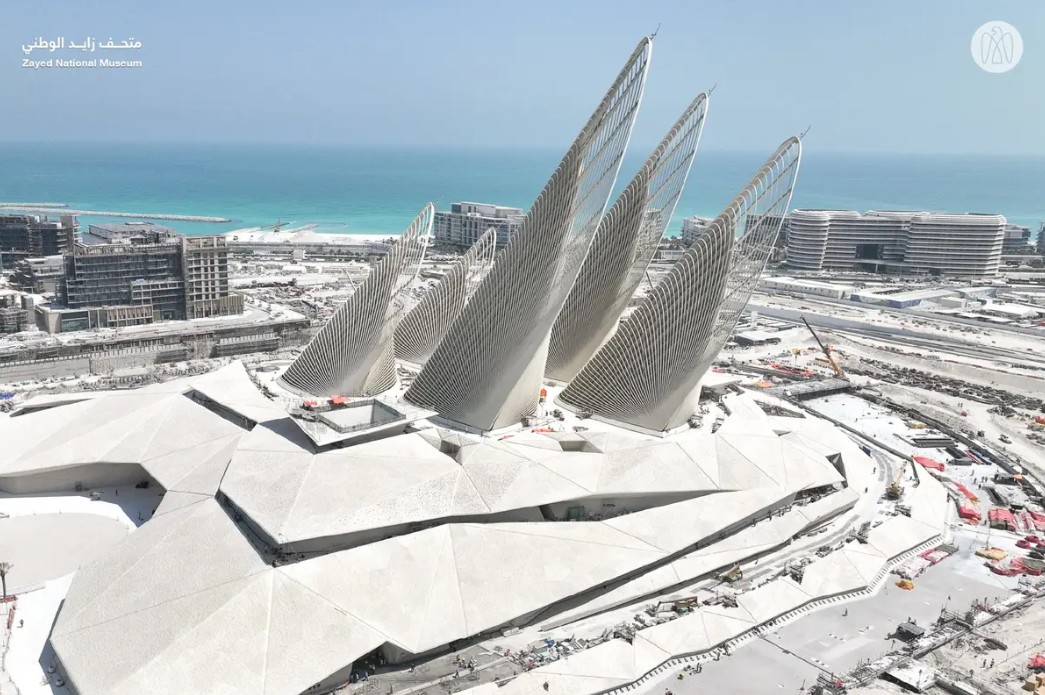
BESIX, in partnership with Trojan General Contracting, has delivered the Zayed National Museum, a landmark of architectural and cultural significance on Saadiyat Island, Abu Dhabi. Designed by Foster + Partners, the museum stands as a tribute to the founding father of the United Arab Emirates, Sheikh Zayed bin Sultan Al Nahyan.
As the centerpiece of Abu Dhabi’s Saadiyat Cultural District, the Zayed National Museum joins the Louvre Abu Dhabi and the upcoming Guggenheim Abu Dhabi, also under construction by BESIX.
In 2021, BESIX and its local partner Trojan General Contracting were awarded the contract by the Department of Culture and Tourism of Abu Dhabi to resume and complete the project that started in 2018 and was at a standstill due to the bankruptcy of the previous contractor.
This takeover involved restarting construction, introducing new engineering approaches and addressing structural challenges left by the previous contractor. BESIX’s in-house design and engineering teams then developed innovative construction methods to meet the project’s unique demands. Coordination was key throughout the construction phase, with the project team harmonizing the efforts of architects, steel fabricators and subcontractors.
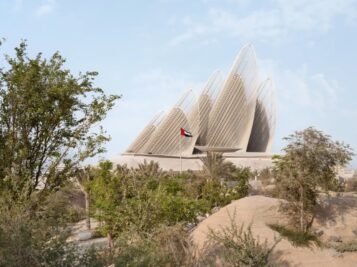
The museum’s striking design is defined by five soaring steel wings, inspired by the falcon — the UAE’s national symbol. These wings house galleries dedicated to Sheikh Zayed’s legacy in education, sustainability, conservation and culture.
The project integrates three key components:
- Museum, with its five iconic wings and four pods housing immersive exhibitions
- Mound, featuring an outdoor amphitheater and over two kilometers of walkways
- Timeline Garden, a landscaped area covering 40,250 square meters that narrates the country’s history.
The wings — considered marvels of engineering — were constructed as lightweight steel towers rising up to 123 meters. They function as solar thermal chimneys, promoting natural ventilation throughout the museum: cool air enters at the base, while hot air is drawn up and expelled through the tower — a modern echo of traditional Emirati barjeel wind towers. Steel was chosen for its sculptural potential, light weight and cost-efficiency, enabling the ambitious design of the wings to be realized in a way no other material could. Onsite welding operations met the highest standards of precision and strength, followed by the delicate integration of glass with curved steel structures, where any defect in steel directly impacted glass fitting.
For the construction of the mound at the base of the museum, project engineering teams adopted an innovative approach. Instead of using traditional glass-fiber reinforced concrete, they created a hybrid solution with the manufacturer: a GFRC structure topped with a layer of molded white concrete to achieve a more “cast-in-situ” finish and achieve the architect’s vision.
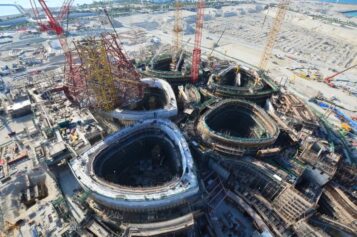
A defining moment came during the installation of the four 600 ton pods housing the museum’s galleries. The structures were delicately craned, using the world’s second-largest crane with a 5,000-ton capacity, into concrete ring beams beneath the future steel “cages” formed by the wing towers.
The use of Building Information Modeling was crucial, allowing the teams to centralize and visualize data from all stakeholders and ensure seamless integration of the wings’ complex curves and supporting structures.
 Join our thriving community of 70,000+ superintendents and trade professionals on LinkedIn!
 Search our job board for your next opportunity, or post an opening within your company.
 Subscribe to our monthly
Construction Superintendent eNewsletter and stay current.
Subscribe to our monthly
Construction Superintendent eNewsletter and stay current.