
The U.S. Green Building Council announced the Top 10 States for LEED in 2025, recognizing the U.S. states with the most LEED-certified commercial space per capita in the last year. With the U.S. remaining the world’s leading market for LEED certification, the annual ranking highlights the public and private sector leaders advancing healthier, more resilient buildings and communities through Leadership in Energy and Environmental Design.
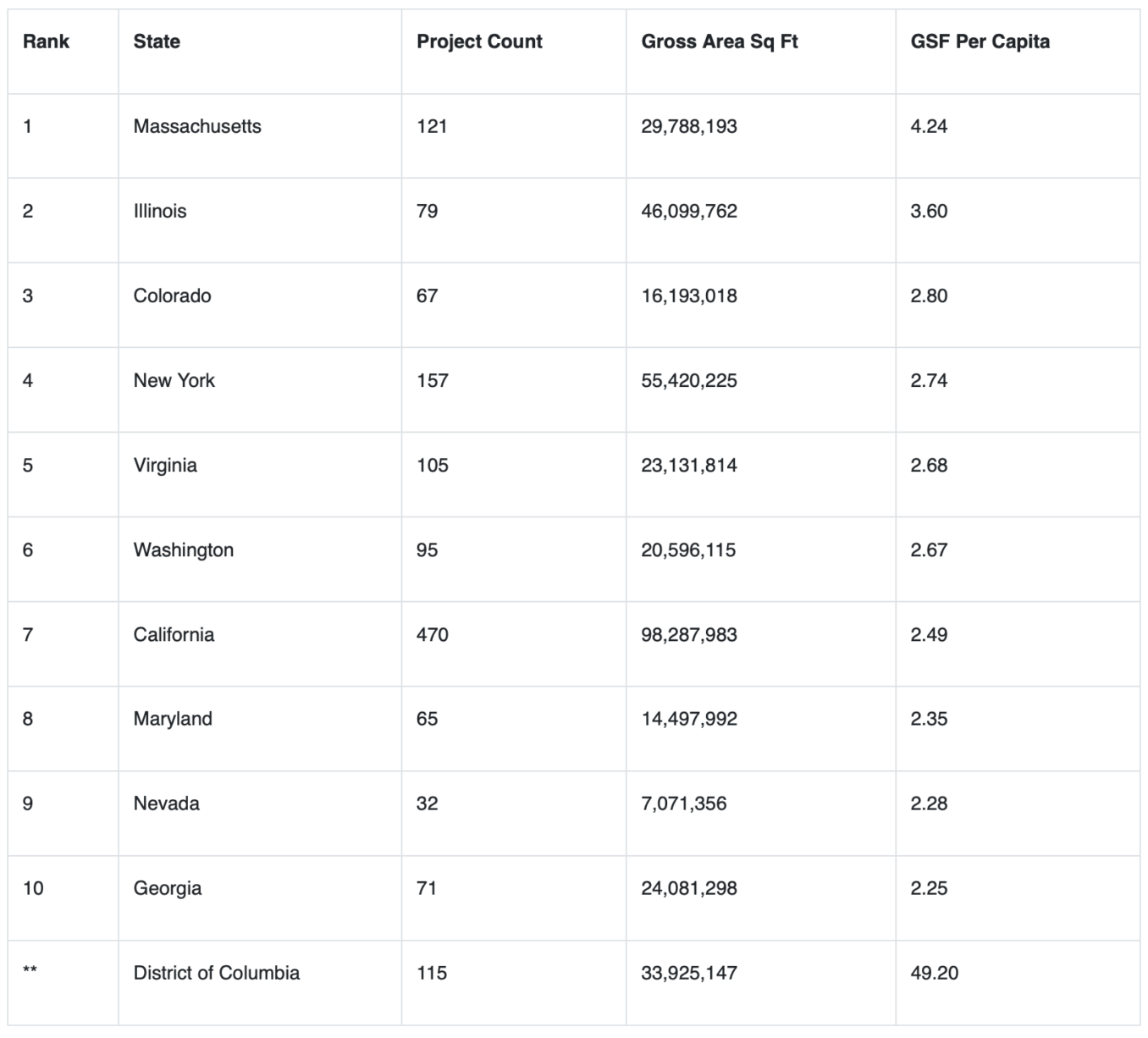
For the second consecutive year, Massachusetts held onto the top spot while Illinois remained in second place in the annual ranking. Colorado climbed six spots to third place while Georgia cracked into the Top 10 States for LEED for the first time since 2023.
In 2025, LEED adoption continued to accelerate nationwide, with thousands of projects designed, built and operated to save energy, reduce waste and improve occupant health. While office buildings and higher education projects remain strong sectors in LEED adoption, innovation-focused sectors — life sciences, data centers and advanced manufacturing — are fueling notable growth in several top states. Additionally, recertifications are helping raise performance in existing buildings, signaling a market-wide commitment to continuous improvement and high performance in the built environment.
Innovation-led sectors are expanding their LEED footprints, reflecting broader shifts in the U.S. economy. Data center growth is particularly strong in Virginia and California, where owners are prioritizing energy efficiency, grid readiness and operational resilience. In Virginia, the continued expansion of digital infrastructure demonstrates how LEED can help optimize energy-intensive facilities. These trends point to a market where high-performance design and operations are fundamental to delivering reliable, resilient facilities.
U.S. LEED adoption among office buildings remains strong, driven by owners investing in healthier, more efficient spaces that support productivity and employee well-being. A growing share of activity is focused on recertification and performance upgrades. Across states such as New York, Illinois and Georgia, owners are leveraging LEED to modernize existing buildings, validate performance for tenants and demonstrate measurable progress toward corporate and environmental commitments.
High-performance building is also widening in scope, reaching large-scale projects such as airports and sports and entertainment venues. Prominent projects such as the Las Vegas Convention Center and Soldier Field in Chicago illustrate how major event destinations can advance energy, water and waste performance while maintaining world-class visitor experiences.
Across the country, the U.S. saw several LEED v5 early adopter certifications. These projects demonstrate deeper carbon reductions, grid-interactive efficiency and enhanced human health. LEED v5 provides a practical, outcomes-focused framework. Among the LEED v5 early adopter projects, the Empire State Building’s LEED v5 Platinum milestone anchors this shift and signals how iconic buildings can lead the way—pairing decarbonization strategies with strong indoor environmental quality and performance verification.
The Top 10 States for LEED are ranked based on newly certified space in 2025. While not officially part of the rankings, the District of Columbia is also recognized for its nation-leading concentration of LEED-certified space. The 2025 Top 10 States for LEED rankings are as follows:
 Join our thriving community of 70,000+ superintendents and trade professionals on LinkedIn!
 Search our job board for your next opportunity, or post an opening within your company.
 Subscribe to our monthly
Construction Superintendent eNewsletter and stay current.
Subscribe to our monthly
Construction Superintendent eNewsletter and stay current.