

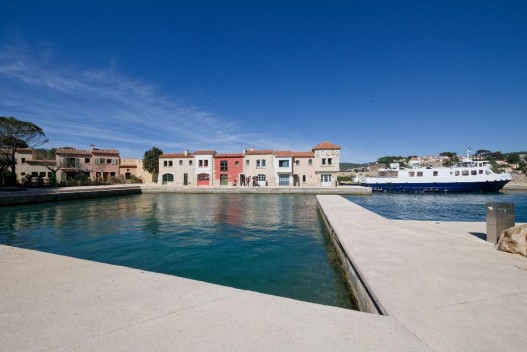
After undergoing several years of renovation, Bendor Island officially reopened and will be open to the public May 1, operating under the Zannier Hotels brand. This iconic project, which was led by the Paul Ricard Company and carried out by a consortium headed by Bouygues Bâtiment Sud-Est, is the crowning achievement of an exceptional development combining heritage restoration, new construction and compliance with stringent environmental requirements.
Just off the coast of Bandol, in the South of France, Bendor Island was acquired by Paul Ricard in 1950. It has undergone a massive transformation that has brought it up to date, while maintaining its heritage. The project was designed by Hardel Le Bihan Architectes and involved the restoration, renovation and construction of a total of 25 buildings, spanning a total area of 28,000 square meters.
There are now 93 hotel rooms across the island, which all form part of a village-like complex. In addition to its carefully controlled capacity, the site features two restaurants, spa, conference center, artisan workshops, water sports facilities and public spaces designed as social hubs. The resort is intended to cater for both leisure stays and special events in a unified setting, and Bandol residents are able to visit freely during the day. The site also includes accommodation for operational personnel.
Work on the site called for a dedicated logistics operation. All supplies and site waste were transported by sea, using a marine service to deliver materials and remove waste. At peak activity, up to 500 people were working onsite daily.
Undertaking this project involved tackling significant technical constraints specific to the site’s unique features. The land is subject to considerable geotechnical variations, as well as groundwater at shallow depths, further complicating the earthworks. The coastal environment led to prioritizing adapted technical solutions, such as the use of specialty marine concrete, resistant to these conditions.
Around 90% of the materials from the demolition and earthworks phases were recovered directly onsite. An estimated 25,000 tons of excavated material were subsequently processed and reused, virtually creating a self-sufficient supply of backfill material and drastically reducing the need for off-site disposal. For waste management, a multi-stream system was implemented, along with specific recovery measures such as organic waste composting and water recycling. This approach to sustainability was further supported by the use of energy-efficient equipment, such as LED lighting and solar panels.
The project combined extensive refurbishment with new construction, demonstrating the diverse range of expertise that was called for. Some of the existing buildings required major structural work involving significant partial reconstruction, while new structures were built with care to ensure they blended seamlessly into the island’s landscape. The project also included extensive outdoor developments, including the complete refurbishment of the quays, as well as construction of several swimming pools and numerous communal areas.
Particular attention was paid to the architectural integration of the complex. The choice of traditional and sustainable materials was in keeping with the local heritage. The roofs, especially canal roof tiles, and a color palette inspired by the island’s natural landscapes, helped to ensure the project blends harmoniously with its surroundings.
Project stakeholders:
- Client: Société Paul Ricard
- Operator and interior architect: Zannier Hotels
- Architect: Hardel Le Bihan Architectes
- Construction: Bouygues Bâtiment Sud-Est
- Project management (client representative): HPM
- Execution project management: Builders & Partners
- Co-contractors: Equans – Inéo (HV/LV electrical works), Colas, Provence Froid (kitchens)
Image: Véronique Pau
 Join our thriving community of 70,000+ superintendents and trade professionals on LinkedIn!
 Search our job board for your next opportunity, or post an opening within your company.
 Subscribe to our monthly
Construction Superintendent eNewsletter and stay current.
Subscribe to our monthly
Construction Superintendent eNewsletter and stay current.