

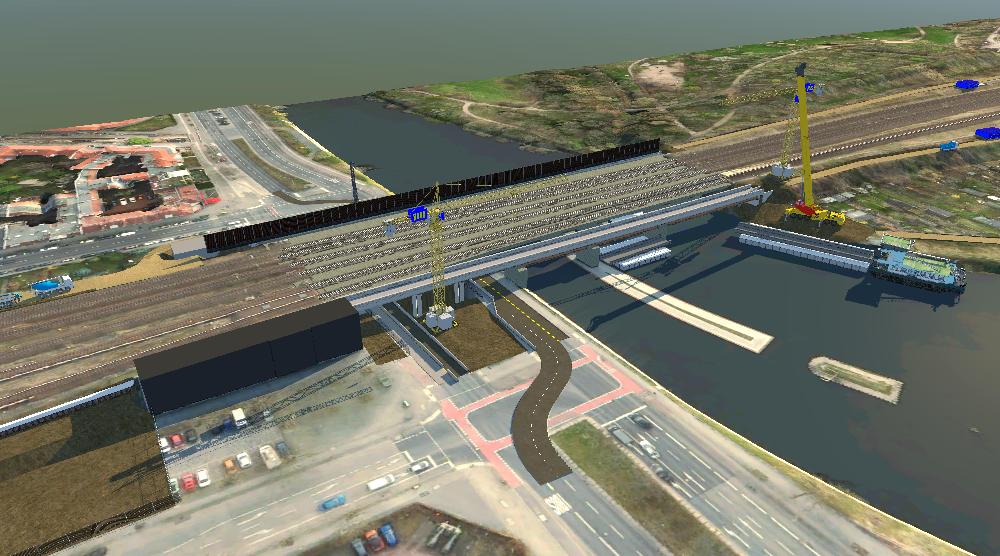
The Siemensbahn, a historic landmark of Berlin, Germany’s transport infrastructure, is being reactivated after more than 40 years of disuse. As part of the “i2030 – More Tracks for Berlin and Brandenburg” project, a modern, high-performance link between Jungfernheide and Gartenfeld is being established. Deutsche Bahn has opted for a track partnership model (“Partnerschaftsmodell Schiene”) for the implementation. PORR is the contractual partner for contract package 2 “KIB Neubau.”
Around 24,000 people worked in Siemensstadt as early as 1912/1913 — it has long been one of Berlin’s largest industrial sites. The Siemensbahn was opened in 1929 to improve transport connections for Siemens employees and local residents. After the disruptions caused by the Second World War and the boycott of the S-Bahn that began with the construction of the Berlin Wall, the line was closed in 1980 and remained unused for decades.
With i2030, the connection is being revitalized to meet current transport needs. The Siemensbahn will give Siemensstadt Square, a residential and innovation area, a direct connection to the Ringbahn Istanbul — with fast links to Berlin Central Station and Berlin Brandenburg Airport. The entire project covers a distance of around 4.5 kilometers in northwest Berlin, from Westhafen via Jungfernheide, through the Charlottenburg district and Siemensstadt to Gartenfeld.
This critical infrastructure project sees the PORR – KEMNA BAU – MCE consortium responsible for contract package 2, “KIB Neubau” (KIB new build). This includes the construction of all civil engineering structures including railway bridges, stations, pedestrian tunnels, noise barriers and retaining structures in the section between Westhafen station, and the “Unteren Spreebrücken” at the junction, with the existing elevated railway line and in the area of Gartenfeld station. In addition, the package involves earthworks and civil engineering services, as well as the development and construction of logistics areas for the entire project.
The track partnership model is being applied in the eastern region for the Siemensbahn project. This model is based on integrated collaboration: Planning and implementation are carried out jointly and across multiple disciplines from the very outset. This allows synergies to be leveraged, quality to be assured and deadlines and costs to be met reliably. The aim is the efficient and sustainable re-establishment of the line between Jungfernheide and Gartenfeld – contributing to modern and environmentally sound transport in the region of the capital.
The works are being carried out in an inner-city environment, in some cases alongside existing railway infrastructure that remains in operation. This requires precise logistics planning and the execution of numerous activities within the narrow time windows provided by Deutsche Bahn. In addition, the project involves interventions in existing buildings with heritage conservation requirements, as well as works in the vicinity of the River Spree. A BIM model has already been developed during the tender phase to take the complex logistics into account early on and to ensure efficient project delivery.
 Join our thriving community of 70,000+ superintendents and trade professionals on LinkedIn!
 Search our job board for your next opportunity, or post an opening within your company.
 Subscribe to our monthly
Construction Superintendent eNewsletter and stay current.
Subscribe to our monthly
Construction Superintendent eNewsletter and stay current.