

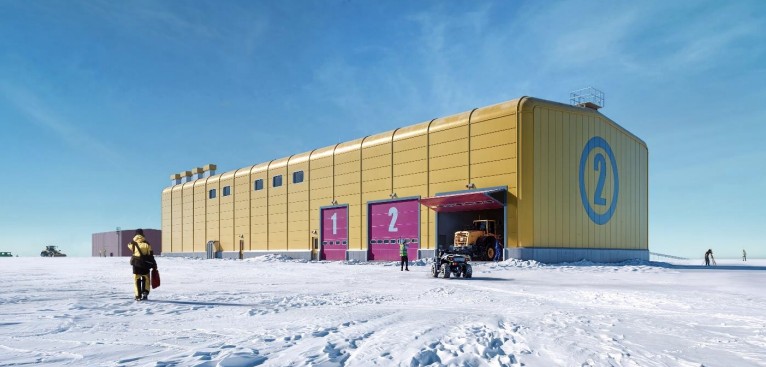
The modernization of the Davis Research Station, built in the 1950s, will enable Australia to secure the expeditions of its scientific base while reducing its environmental footprint. This reinforcement of Australia’s long-term presence in Antarctica will strengthen and develop the important scientific research into the world’s climate.
Undertaken by the Australian Antarctic Division with an alliance including Bouygues Construction Australia, Stantec and Mott McDonald, this project to modernize Davis Station will include:
- Replacement of water production systems
- Construction of a new main powerhouse
- Development of a new vehicle workshop
- Refurbishment of the existing trades workshop
- Overhaul of site-wide services reticulation
- Decommissioning and removal of legacy infrastructure
These improvements will enable the Davis Station to continue operating at full capacity, while improving employee safety and the efficiency of scientific missions in one of the most extreme environments on the planet.
Davis Station is Australia’s southernmost Antarctic station. It is located near the Vestfold Hills, on the Ingrid Christensen Coast of Princess Elisabeth Land. The station is around 20 kilometers from the edge of the continental pack ice.
There are significant logistical challenges working in the harsh Antarctic environment. Davis Station experiences very strong winds, with gusts of over 200 kilometers an hour and the average winter temperature sits at around -21 C, sometimes plummeting to -42 C.
For this reason, the construction season is limited to the warmer months of October through February, with no extensions possible. It is the only Australian station without a natural freshwater source, relying on reverse osmosis and shipped water, which limits supply during winter and caps population numbers.
The project has a focus on employing local specialists based in Tasmania who will be selected between the Alliance members with qualified workers traveling to Antarctica each season.
The entire project will be subject to stringent environmental approvals, in accordance with the Antarctic Treaty (Environmental Protection) Act 1980 and the Environment Protection and Biodiversity Conservation Act.
The project will start at the end of 2026 with delivery scheduled for 2032.
Image courtesy of Hugh Broughton Architects
 Join our thriving community of 70,000+ superintendents and trade professionals on LinkedIn!
 Search our job board for your next opportunity, or post an opening within your company.
 Subscribe to our monthly
Construction Superintendent eNewsletter and stay current.
Subscribe to our monthly
Construction Superintendent eNewsletter and stay current.